Finding the Edge
Hello there. I’m Ricardo Youle, founder of Optimized Simplicity and an implementation strategist. I help creators turn information overload into clarity, systems, and results.
Finding the Edge is a field guide for anyone drowning in saved content who’s finally ready to use it. It’s the system I built inside Recall to turn a pile of saved articles, videos, and notes into something that actually thinks with me.
Ten short trails, walked at your own pace. No system to build today. Just the next small step. Written for fellow Recall users. The story of how I stopped collecting knowledge and started actually using it.
Prefer a short walkthrough first? Ricardo also recorded how he turns scattered saves into connected ideas.
Ricardo wrote this field guide as a shared notebook in Recall. Open Finding the Edge to walk the trails in his original, follow along, and share it with others.
The Trail Map 🗺️
Prefer a checklist you can tick? Copy Finding the Edge: The Trail Board to your own Trello account. Every trail is a card, every Trail Marker is a checklist you can tick as you go.
You will see a little map at the top of each chapter. A trail, a marker showing where you are, how far you’ve come. That’s on purpose. I didn’t want you to memorize a system. I wanted you to feel like you were walking somewhere.
So here’s the shape of the walk, before you take the first step.
Ten trails. Each one short. Each one a single lesson I learned the slow way, usually after getting it wrong first. We start where I started, drowning in saved content I never reused. Then the audit, the moment I stopped collecting and started releasing. Then the rules I wrote for myself, the habits that made them stick, the split between what I collected and what I actually made. Near the end, the quiet payoff that only shows up months later. And last, the part I didn’t expect, handing what I’d built to someone who came after me.
You don’t need to walk them in order. You don’t need to walk them today. Take what serves you. Modify what almost works. Leave the rest.
By the final chapter you’ll see the whole trail in one image, the entire path you walked. But that picture only means something if you walk it.
| Trail | Title | Reading Time | What You’ll Find |
|---|---|---|---|
| Trail 0 | 🥾 Day One | 5 min | The smallest possible start: three real saves and one question. |
| Trail 1 | 🪤 The Collector’s Trap | 12 min | Why we drown in information scatter and how to find your “why.” |
| Trail 2 | 🧭 The Discovery | 10 min | Shifting from being a librarian to becoming a connection engine. |
| Trail 3 | 🧹 The Audit | 12 min | A monthly ritual to sweep out orphan tags and reclaim clarity. |
| Trail 4 | 📜 A Tagging Constitution | 10 min | Four rules to keep your knowledge base from rotting over time. |
| Trail 5 | 🔁 The Five Habits | 12 min | Daily practices that turn rules into an effortless second nature. |
| Trail 6 | 🌱 The Compounding Edge | 10 min | Why the real payoff takes months and how to survive the gap. |
| Trail 7 | 🛠️ Library vs. Workshop | 15 min | The one distinction that separates collecting from creating. |
| Trail 8 | 🤖 The Chat’s Limits | 12 min | An honest look at the AI’s edges and how to work with them. |
| Trail 9 | 🪧 The Legacy Layer | 10 min | Moving from private research to public-facing curated playlists. |
After the ten trails, four short closing sections: the doubts I’d answer honestly (Yeah, But…), the whole walk pressed onto one page, the people who walked it with me, and the one move I saved for last.
Expand each trail below.
Pre-workBefore You Walk 📍
Who Is This Actually For?
(Read this before you decide whether to keep walking)
⏱ About 2 minutes.
I have to be honest about something before we start, because it took me a while to see it myself.
For most of the time I was building this, the “why” was about me. A sharper mind. A cleaner system. My edge. And that’s real. It’s most of what the trails ahead will give you.
But a knowledge base that only makes me sharper is a small thing. It dies with me.
The part that kept surprising me was what happened when my thinking left my own head. When I handed one synthesis to a friend who needed it. When a note I wrote helped someone think something they couldn’t think before. That’s when the saving stopped being about hoarding an edge and started being about having something worth giving.
So here’s the real question under all the tags and habits and trails. Not “how do I get smarter.” It’s this: *“*what do you want to be able to give, once you can finally think clearly?”
Maybe you’re building toward work that helps people. Maybe you want to teach something, or make something, or just be the person in the room who connects the dots no one else can. Whatever it is, that’s your why. Not the system. The system is just how you get there.
Keep that question in your pocket as you walk. The trails will make you sharper. But sharper for what is the thing only you can answer, and it’s the thing that turns this from a productivity project into something that actually matters. Brendon Burchard says it in one line: “No matter how small you start, start something that matters.” That’s the whole spirit of this guide. Trail 0 is the small start. The question I just asked you above is the part that makes it matter.
You don’t need to save more. You need what you already saved to finally mean something. That’s the whole promise. Trails 0 through 9, and the first one takes about five minutes.
The trail is open. Let’s begin.
Trail 0Day One 🥾
If You Just Opened Recall, Start Here
(The Only Chapter You Need Today)
⏱ About 5 minutes. The rest of the guide can wait.
If you’re brand new, I want to protect you from the mistake I made.
When I started, I tried to build the perfect system on day one. I read about tagging methods. I planned hierarchies. I watched tutorials on features I hadn’t earned yet. I spent my whole first week preparing to use Recall instead of actually using it. By the time I saved my first real thing, I was already worn out and I had learned nothing.
So here’s the opposite of that. The smallest possible Day One.
➡️ Do only this, and let the rest of this guide wait until tomorrow.
Step 1: Install the Browser Extension
Get the Recall Google Chrome extension, or the one for Edge, Firefox, or Safari. That’s the whole step. Don’t open the settings, don’t customize anything. We’ll tune all of that later, once you’ve actually got a reason to.
Step 2: Save Three Things You Actually Care About
Find three pieces of content you genuinely want to keep. Not test content. Real things.
- An article you’ve been meaning to read.
- A YouTube video or podcast that stuck with you.
- One more of either.
Click the extension on each one and hit save. Recall summarizes it and files it for you. And it even suggests a tag automatically, so the one thing most people dread about a system like this is already off your plate.
For today, let it help. Lean on the automatic tagging and enjoy how light it feels. Later, in Trail 5, I’ll show you the one setting I turn off on purpose, and why a little friction becomes the point. But that’s tomorrow’s lesson. Today, you stay in control of what gets saved, and Recall handles the rest.
Step 3: Open One of Them and Ask It a Question
Open one of your three cards in Recall. Look for the Chat option on the card and ask it one real question, anything you actually want to know:
Try this: “What’s the one idea here worth remembering?”
Read the answer. That small moment, asking your own saved content a question and getting something useful back, is the entire reason this tool exists. Everything else in this guide is just a way to make that moment happen more often.
One small thing, in case it saves you a headache later. If the chat’s answer is worth keeping, save it to the card’s Notebook. Saving it is what keeps it around for the future.
That’s Day One
Three saves. One question. That’s the whole assignment.
Please don’t bulk-import your bookmarks. Don’t build a tag system. Don’t even read Trail 1 yet.
Let three cards sit in your knowledge base overnight, and come back tomorrow. If you find yourself opening one of those cards again on your own, unprompted, that’s the signal. That small pull back to your own thinking is the whole point. Follow it, and the rest of this guide will make sense. That’s all you need on day one.
Everything after this, why we drown in content, how to keep the system clean, the habits that make it stick, the quiet payoff that shows up months later, is waiting for you in the Trails ahead.
But none of it matters if you never take the first walk. So take it. I’ll see you in Trail 1 tomorrow.
Trail Marker
⏱ Today The First Three: Install the extension. Save three real things. Ask one of them a question. Then close Recall and walk away until tomorrow.
⏱ 10 sec The Skim Version: Install the browser extension right now. That’s the entire first step. The other two can wait until you’re back.
Trail 1The Collector's Trap 🪤
Why I Was Drowning in Information Scatter
(And Why It Wasn’t My Fault)
⏱ About 12 minutes to read.
I’ve been living inside Recall for about three months as I write this.
I’m not lazy. I’m not undisciplined. But I told myself I was, for years. The truth was simpler and less shameful. I was living with something I started calling information* scatter. That feeling of being spread too thin across too many apps. Important content scattered across my bookmarks, notes, messages-to-self, and apps that never talked to each other.
And it wasn’t my fault. The tools were built to scatter me. Every app wanted me to save into it, not connect across the others. I was handed tools that fragment by design, and then I blamed myself for the fragmentation.
There’s a word for what was happening to my knowledge base. Entropy. Left alone, everything drifts toward disorder. Your room, your inbox, your saved content. Nobody has to make it messy. It gets messy on its own, just by sitting there. So a scattered knowledge base isn’t proof you’re undisciplined. It’s just proof you stopped fighting the drift. That’s all the rest of this guide really is: how to push back, on purpose.
What I Was Actually Missing
But the scatter was never the real problem. It was just what I could see. The real problem was what it hid: I had been collecting knowledge without ever integrating it.
There’s a scene in Good Will Hunting that named this for me. Will (Matt Damon) isn’t ignorant. He’s the opposite. He’s read everything, remembers all of it, can out-argue anyone in the room. But his therapist, Sean (Robin Williams), sees the gap underneath the brilliance:
Sean Maguire, on the park bench: “If I asked you about art you’d probably give me the skinny on every art book ever written… but I bet you can’t tell me what it smells like in the Sistine Chapel*.”* 📽️ Watch Video - Exact Moment
If you know the movie, you know Sean’s speech is about life, not note-taking. I’m borrowing it as a metaphor because that gap he names, knowing facts versus living them, is exactly the one I kept falling into with everything I saved.
Yes, that was me. I had the knowledge. What I didn’t have was the lived weight of it. I could recite every fact about the Sistine Chapel, but I’d never stood under that ceiling and been changed by it. My knowing was real, but it was secondhand. Collected, never integrated.
That’s information scatter, in one scene. A bookmarks bar full of art books with no Sistine Chapel inside.
And later, when I moved to Recall, I learned a knowledge base can fill up the very same way. A wall of cards, none of them I’d actually stood inside.
Look at your own saved list for a second. How much of it have you actually stood inside, and how much have you just shelved?
I had to ask myself the same thing. That’s the trap a scattered knowledge base sets for us. It’s not that we know nothing. It’s that we collect endlessly and integrate almost nothing:
- The YouTube video we saved for one brilliant moment, then never went back to find.
- The podcast we finished but couldn’t repeat a single idea from an hour later.
- The PDF we meant to “read properly later,” still unopened months on.
- The saved article we can cite but that never shifted how we think.
And the list goes on… Knowledge with no weight, because we never actually let it in.
The People Who Built Recall Also Had My Problem
It turned out I wasn’t the only one. Sankari, one of Recall’s co-founders, described the same thing I was feeling, just better than I could. She shared her five personal use cases:
“Like many of you, I have been drowning in content. Bookmarked articles I’d never read again. Podcasts I’d listened to but couldn’t remember. YouTube videos with one brilliant insight buried in three hours of footage. I had all this information saved everywhere, but none of it was actually useful.” - Sankari Nair (Recall)
Paul, Recall’s co-founder and CEO, wrote during Recall’s launch that he lived the problem long before he built the fix:
“Despite trying every trending knowledge management tool out there, I consistently found myself spending more time meticulously crafting and categorizing my notes, only to forget about them when I needed them most.” - Paul Richards (Recall)
That stopped me when I first read it. The people who built Recall didn’t start with a tool. They started with the same problem I had. For a long time I kept treating my messy bookmarks as a tool problem. They weren’t. That realization is where this whole thing started for me.
So I stopped asking what tool would fix me, and started asking what I was actually for. The line on Recall’s own homepage puts the stakes plainly: *“*AI gave everyone the same brain. Your knowledge is your edge.”
A scattered knowledge base cost me more than a messy shelf. It cost me my edge. That’s where the name of this guide comes from.
Where I Got Stuck
And here’s where I stayed stuck for a long time. I’d confused a goal with a purpose, and I couldn’t see it.
Simon Sinek puts it cleanly: “How do people who have lost fulfillment in their why cope with that transition? Very simple answer. That was never their why to begin with. People confuse goals with purpose. It happens all the time.” 📽️ Watch Video - Exact Moment
Read that again. ⬆️ I had to.
Because that was me, exactly. I’d made “save more articles” my goal, and somewhere along the way I’d mistaken it for a purpose. But a goal dressed up as a purpose will exhaust you. I know, because it exhausted me.
Mel Robbins describes this trap in a different context: “You’re probably familiar with that phrase, ‘I’ll be happy when.’ We all succumb to that thinking. ‘I’ll be happy when I lose the weight, I fall in love, I land that dream job.’ If you think you’ll be happier when you achieve something, what always happens is when you achieve it, you’re not as happy as you thought you would be. And then, because you don’t have this big goal in front of you anymore, your happiness plummets.” 📽️ Watch Video - Exact Moment
That was my whole relationship with saving. One more article and I’ll finally get it. But the next save was never the thing. My bookmarks bar looked impressive. My Notion was a maze of nested pages. And I couldn’t find what mattered when I needed it.
🕵️ Voices of the Field — Why the Scatter Hurts
The pain isn’t imagined. It’s been diagnosed by people I trust:
- Brendon Burchard: *“*Information overload is destroying your mental performance.” He frames it as a high-performance killer. He’s right.
- Cal Newport names what doom-scrolling does to us: the slow erosion into what he calls the cognitive shallows. And the good news is, it’s reversible through what he calls cognitive fitness.
- Dr. Gabor Maté**** goes deeper. He puts scattered attention in his list of “5 Regrets Trapping People From A Life Of Purpose.” For him it’s not a productivity glitch. It’s a soul-level disconnection.
- Matthew McConaughey (Greenlights) flips the diagnosis: “Finding your identity is more a process of elimination than discovery.” That line stuck with me. I’d been trying to discover what was worth saving. He told me to do the opposite, to rule out what wasn’t. Define what doesn’t earn your attention first, and what’s left is worth keeping.
This Trail is the Proof
Here’s the part I want to point at directly, because it’s the whole thesis happening in real time.
None of the connections in this trail arrived gift-wrapped. The Good Will Hunting scene, Simon Sinek on goals versus purpose, Mel Robbins on the “I’ll be happy when” trap, Brendon Burchard, Cal Newport, Dr. Gabor Maté, Matthew McConaughey. I didn’t have those lined up in my head, ready to quote. They were scattered across months of saving, a movie here, a podcast there, a book I’d half-forgotten.
What pulled them into one argument was the work I keep talking about. I cross-analyzed. I sat in the chat and asked what one card had to do with another. I ran the same question through a few cycles, pushing back when the first answer was lazy. And slowly a movie scene, a leadership talk, and a productivity reframe started speaking to each other, even though I saved them weeks apart with no plan of connecting them.
That is integration. Not me being clever. Me asking my own saved content the right questions until the scattered pieces became a single thought.
This trail you’re reading is the output of the exact thing it’s trying to teach you.
Where I landed, eventually:
Bookmarks are graveyards. Notes apps are silos. I needed a bridge… but more importantly, I needed to know WHY I was crossing it.
Trail Marker
⏱ 60 sec The Diagnostic: Ask yourself: If my knowledge management tool disappeared tomorrow, would I still know WHY I save things? If the answer is no, you’ve been chasing a goal. If the answer is yes, you have a purpose, and Recall becomes the engine that serves it*.*
⏱ 10 sec The Skim Version: Look at your bookmarks bar right now. Just look. Notice how you feel.
Trail 2The Discovery 🧭
How I Stopped Just Saving and Started Connecting
(And Why I Stopped Being a Librarian)
⏱ About 10 minutes to read.
For a long time, I was a collector. I didn’t call it that, of course. I called it “researching” or “staying informed.” I would see a great article, click the save button, and feel a tiny hit of dopamine. I told myself I had acquired the knowledge just by filing it away.
But the truth was, my knowledge base was just a digital attic. I was putting things in boxes, stacking them to the ceiling, and never opening them again. I had hundreds of cards, but I wasn’t any smarter. I was just more cluttered.
The Shift That Changed Everything
The breakthrough didn’t come from a new feature. It came from a shift in how I saw the cards. I realized that a card sitting alone is just data. It only becomes knowledge when it touches something else I already know.
I stopped asking, “Where should I file this?” and started asking, “What does this remind me of?”
That one question changed my entire workflow. I stopped treating Recall as a Read-It-Later app and started treating it as a connection engine.
Why I Left the Others Behind
I had tried everything else. I always felt like I was working for the tool instead of the tool working for me.
I spent months in Obsidian. I got lost in the manual labor of linking. I was building a library, not a second brain. I fell into the plugin trap and spent my mornings browsing the community directory instead of writing. I would install a new theme just to feel productive and then spend hours configuring a calendar plugin that I never actually used. I was managing a system, not a thought process.
I tried Notion. It felt like a playground at first. Then it became a maze of nested pages. I built databases seven layers deep. My best ideas were buried so far down I couldn’t find them when I needed them. The system was beautiful, but it was a graveyard for my insights.
Even NotebookLM felt like a cage. I liked the AI grounding, but every notebook was its own island. My research on one project couldn’t see my research on another. I felt like I was renting a brain instead of building one.
I was tired of the maintenance. I was tired of the limits. I needed a tool that acted like a partner, not a project.
Recall felt different because it was the first tool that met me halfway. It didn’t wait for me to do all the work; it started surfacing connections for me. It was like having a research assistant who had read everything I’d ever saved and was constantly whispering, “Hey, this thing you’re reading right now? It’s actually related to that podcast you heard three weeks ago.”
The Breakthrough Insight
The moment it finally clicked for me was when I stopped just saving content and started connecting it and chatting with it.
Suddenly:
- I’d read about a concept like “Progressive Summarization,” and Recall would show me every other time I’d encountered that idea in a podcast or a book.
- I’d want to build a personalized protocol for my health, and I could chat across all my research at once to find the patterns.
I wasn’t just collecting art books anymore. I was finally standing inside the chapel. I could smell the paint, not just recite the dates.
The Curation Revolution
That shift in perspective changed how I saw my role. I realized I wasn’t just a “user” anymore. I was becoming what Tiago Forte calls… a Context Architect.
🕵️ Voices of the Field
- Tiago Forte: His CODE method (Capture, Organize, Distill, Express) finally made sense to me. Recall handles the “Capture” and “Organize” so well that I could finally spend my energy on the “Distill” and “Express.”
- Andrej Karpathy: his viral idea of a personal LLM knowledge base is basically what I was building without knowing it had a name, a version of myself that remembers everything I’ve learned.
- Max Bernstein: He warned that AI output is often disappointing because it lacks context. I found that by building my own knowledge base, I was giving the AI the “soul” it was missing.
Lookout Point I stopped building a library of what the world thinks and started building a map of how I think.
Trail Marker
⏱ 5 min The Connection Test: Open the last card you saved. Don’t look at the summary. Go straight to the Connections tab. Find one related card that surprises you. Click it. Ask yourself: How do these two ideas change each other?
⏱ 10 sec The Skim Version: Open your Knowledge Graph right now. Just look at the web of lines. You aren’t looking at files; you’re looking at your own mind.
Trail 3The Audit 🧹
When My Knowledge Base Cracked
(And How I Brought It Back)
⏱ About 12 minutes to read.
For the first few months, I felt invincible. I was saving everything. My Knowledge Graph was growing into a beautiful, dense web of lines. I felt like I was finally winning the war against information scatter.
But then the cracks started to show.
I went looking for a specific insight on “productivity,” and I found four different tags: Productivity, Efficiency, Workflows, and Deep Work. Some cards were in one, some in another, some in all four. My “self-organizing” system had quietly become a “self-complicating” one. I had thousands of cards and couldn’t find the one I actually needed. I’d built a digital graveyard, and I was the only one who didn’t know where anything was buried.
A Real Failure I’d Rather Not Mention
I remember a Saturday morning in early April, about three weeks in. I opened my tag panel and just stared at it. Tags for different months. Tags for platforms (YouTube, X, Substack). Dozens of orphan tags with a single card trapped inside them.
I felt that familiar wave of overwhelm. And my first instinct wasn’t to fix it. It was to quit. I closed the laptop and didn’t open Recall for about three days. I told myself the tool was broken. But the tool wasn’t broken.** I just had not given myself permission to let anything go.
When I finally came back, I didn’t try to fix everything at once. That was the real lesson: an audit isn’t a technical chore. It’s an emotional one.
The Audit Methodology
I worked out a three-step ritual I now run every month. It’s not about perfection. It’s about hygiene.
Step 1: Orphan Cleanup
The meaningless tags go first. If a tag doesn’t help me think, it doesn’t deserve to exist. I parked geographic metadata like New York City under a parent tag like Movie, where it actually meant something, and I deleted the date and platform tags that told me nothing about the content.
Step 2: The Critical Distinction
I realized I’d been mixing two completely different kinds of cards in the same drawer: content about the world, and artifacts I had made. Separating them was the single change that brought the overwhelm down. (It mattered enough that I gave it its own chapter later, in Trail 7.)
Step 3: Tag Hygiene Ritual
Fifteen minutes, once a month. Tags with only one or two cards get merged. Tags that have ballooned past fifty get split. I’m not chasing a perfect system. I’m just keeping the paths clear so I can still walk them. (I later turned this into a standing rule, in Trail 4.)
Persist, Pivot, or Concede
Matthew McConaughey has the cleanest decision frame I’ve found for this, from Greenlights: “If you persist and try to get something done over and over and still get the same outcome that you didn’t want, wait a minute. Persistence is not my jam here.”
Most of my rotting tags were persistence problems in disguise. I was clinging to structures that didn’t work because deleting them felt like admitting I’d been wrong. Now I give myself permission to concede a tag and pivot the structure. Very few things in a knowledge base deserve raw persistence.
I found the cleaner version of this idea in Mel Robbins, of all places. Not in a productivity book. In her Let Them Theory, which is really a theory about control.
Her whole point is that we burn enormous energy trying to manage things we were never holding. Her move is two words. Let them. And then the part people forget, the second half: let me. As she puts it, “when you say ‘let me,’ you remind yourself: I can choose what I’m going to think, say, or do in response.”
That’s the audit, exactly. Let them be the messy tags I made when I didn’t know better. I can’t un-save four months of clutter. So I let it be what it was. And then let me. Let me choose what to delete now.
The cleanup was never about controlling the past mess. It was about reclaiming the one thing I actually hold, which is what I keep going forward.
The orphan tags don’t need defending. I just had to stop managing a past I couldn’t change, and start choosing the present I could.
The Hardest Part Is the Permission to Let Go
In Top Gun: Maverick, Iceman (**Val Kilmer), dying and unable to speak, types four words to Maverick (Tom Cruise) still chained to thirty years of guilt: “It’s time to let go.”
That’s what the audit became for me. Not a punishment. Permission. Those orphan tags don’t need defending. They need releasing. 📽️ Watch Video - Exact moment
Lookout Point A clean knowledge base isn’t one that holds everything. It’s one where everything left has a reason to be there.
Trail Marker
⏱ 10 min The 10-Tag Audit: Open your tag panel right now. Find one meaningless tag (a date, a platform, an orphan). Delete it or merge it. Notice how much lighter your graph feels. Now do nine more.
⏱ 10 sec The Skim Version: Open your tag panel and just look. Which tag makes you feel the most cluttered? That’s tomorrow’s first target.
Trail 4A Tagging Constitution 📜
The Rules I Wrote for Myself
(Not Laws. Just What Finally Worked.)
⏱ About 10 minutes to read.
After the audit in Trail 3, I had a clean knowledge base for about a week. Then it started to drift again. New saves came in, the old chaos crept back, and I realized cleaning up once was never going to be enough. I needed rules I could live by, so the mess never had a chance to build up in the first place.
So I wrote myself a constitution. Four rules. They aren’t universal, and they probably aren’t right for everyone. They’re just the ones that finally held. Borrow what’s useful to you.
Rule 1: Every Card Gets a Layer Tag and a Format Tag
Before, my tags were a free-for-all. Now every card gets two: one for what kind of thinking it supports (the layer, like Concept or Person), and one for what it is (the format, like Podcast or Article).
That small discipline turned my knowledge base from a pile into something I could actually navigate. Dan Koe put the principle best: “Don’t find a niche. Become the niche.” My tags shouldn’t describe the whole world. They should describe how I think about it.
Rule 2: Save the Synthesis, Not the Conversation
I used to save entire AI chats. Every turn, every tangent, every dead end. My knowledge base filled up with transcripts I never reread.
Now I do the opposite. At the end of a session, I ask for one Master Synthesis that captures the actual knowledge produced, and I save that as a single card.
The conversation was the thinking. The synthesis is the result. Only the result is worth keeping.
Robin Good named the deeper truth: use AI as an options generator, not a writer. The AI gives me the raw material. The curation, deciding what’s actually worth keeping, stays mine. That’s the part I refuse to hand over.
Rule 3: Tag It Before You Close the Tab
This is the smallest rule and the one that saves me the most pain. Every saved card gets its tags immediately, before I move on. Not later. Not “when I have time.” Now.
Because I learned this the hard way: an untagged card isn’t a card I can’t find — it’s a card I’ll never run into. Recall remembers it. My browsing never does.
James Clear’s (Atomic Habits) core move is flipping the order most people get backwards. We think goal → action → identity (“I want a second brain, so I’ll save things, and maybe one day I’ll be organized”). He argues it runs the other way: identity → action → goal. You don’t tag because you want a tidy library; you tag because you’ve decided you’re** someone who thinks in connections, and the tidy library is just what that person leaves behind. That’s why small habits compound; each tiny save is a vote for who you’re becoming. I’m not someone who “uses Recall.” The habits built the identity.
Rule 4: Monthly Hygiene Is Not Optional
The audit in Trail 3 wasn’t a one-time rescue. That’s the trap I kept falling into: I’d clean everything up, feel proud, and assume I was done. I never was.
So Rule 4 is simply this: the audit becomes a calendar event*, not a crisis response**. Fifteen minutes, once a month, treated like brushing my teeth. Boring, mandatory, non-dramatic. Brendon Burchard frames maintenance like this as a non-negotiable ritual, not an optional cleanup. The systems that last aren’t the ones built perfectly once. They’re the ones maintained consistently.
The Triage Prompt
To keep the “chaos” from creeping back, I now use a specific prompt before I commit to any save. It forces me to look for connections (what I call the Active Bridge, connecting a new card to ones I already have the moment the link sparks, explained fully in Trail 5) and gives me a “Verdict” on whether the content is actually adding new value or just cluttering my graph. It turns the “auto-save” into a “trial save.” A save that still has to earn its place.
What makes this more than a summary is the Cross-Analysis step. It doesn’t just tell me what a card says. It tells me what the card** touches**, which turns a blind save into a connected one.**
My Triage Prompt
Run on a card right after Recall summarizes it:
Prompt:
“Recall has already summarized this card. Using that summary as your starting point, do the part it doesn’t:
KB Cross-Analysis. Checking against my existing tags and saved topics, identify up to 3 connections to cards I already have. Label each relationship (supports / contradicts / extends / duplicates) and explain the link in one sentence.
Verdict, based on those connections. If it mostly duplicates what I have, lean Skip. If it extends or contradicts something, lean Save. One line: Save, Skip, or Save-with-caveat. (If Skip, end the whole response with: ACTION REQUIRED: DELETE THIS CARD*.)*
Then, only if it’s worth keeping: pull the 3-5 most insightful or memorable quotes, in quotation style.”
I built it in that order on purpose. Recall hands me the summary the second I capture. So the prompt starts where Recall stops.
And where Recall stops is the connection. The summary tells me what a card says. It can’t tell me what the card touches, what it agrees with, argues against, or just repeats from things I already have. That’s the part only I can ask for. So that’s the first thing the prompt does.
The verdict isn’t a separate step. It falls right out of the connections. If a card only duplicates what I’ve got, that’s my answer. If it extends something, or argues with it, that’s worth keeping. The decision makes itself once I can see what the card connects to.
This is the Active Bridge, turned into a habit:
Let Recall summarize. I connect. The connection decides. A blind save becomes a connected one before I’ve even committed to keeping it.
🕵️ Voices of the Field — On Discipline as Freedom
It took me a while to understand that these rules don’t restrict me. They free me.
- Dan Koe: “It’s actually pretty easy to be self-disciplined, if you stop getting distracted.” The rules remove the daily decision-making that used to drain me.
- Codie Sanchez: “Silence is actually a superpower.” I apply it to my knowledge base. Most content doesn’t deserve a tag, because most content doesn’t deserve a save.
- Master Shi Heng Yi: he teaches that distraction is something we allow, not something done to us. A bloated tag tree is just that habit, made visible, one careless save at a time.
Lookout Point The rules aren’t a cage. They’re the banks of the river that let the water finally go somewhere.
Trail Marker
⏱ 5 min Pick One Rule: Don’t adopt all four. Pick the one that scares you most (it’s probably Rule 3, tagging before you close the tab). Commit to it for seven days. Watch what changes.
⏱ 10 sec The Skim Version: Look at the last card you saved. Is it tagged? If not, fix it right now. That’s the whole rule.
Trail 5The Five Habits That Stuck 🔁
The Daily Practice, Filtered Through Real Life
(Adapted From Recall’s Co-Founders, Then Bent to Fit Me)
⏱ About 12 minutes to read.
Rules are one thing. Habits are another. The Tagging Constitution in Trail 4 told me what to do. But rules don’t run themselves. They only work once they dissolve into habits I no longer have to think about.
Sanks, one of Recall’s co-founders, shared her five habits in Recall’s online official documentation. I didn’t adopt them as written. I tried them, broke them, and bent them until they fit my actual life. Here’s what survived.
Habit 1: Pre-Screen Before I Save
This is the one habit of Sanks’s I adopted almost unchanged, because I couldn’t improve on it. Concise summaries, augmented browsing on, auto-save off. I’ll be honest: I didn’t bend this one. I just agreed with it.
The auto-save-off part alone changed how I save, because it forced a pause between seeing something and keeping it. Sometimes the best habit isn’t the one you reinvent. It’s the one you were smart enough not to mess with.
Habit 2 — Keep the Tags Tidy as I Go
The Tagging Constitution in Trail 4 is the what. This habit is the when: I do it as I save, not in a monthly cleanup. A tag fixed in the five seconds after saving never becomes a backlog.
But the reason I actually keep it up is a reframe I borrowed from Sahil Bloom. He calls it being a “Time Billionaire.” Every minute I spend tagging well today is a minute I’m handing back to my future self, the one who won’t have to dig. The tidy-up isn’t admin. It’s a gift I’m mailing forward.
Habit 3 — Chat With My Own Notes, Not Just the Sources
I started chatting not just with saved articles, but with my own journals and notes. Asking my past thinking questions. Finding patterns I couldn’t see while I was living through them.
The trust factor is everything here. The difference from a raw chatbot is that I can point this one at content I chose and vetted. Since Recall 2.0 the chat can reach the open web too, so I set the source to Recall when I want the answer built only from my own cards. In that mode it isn’t pulling from anywhere I didn’t approve. Just me, in conversation with a more organized version of myself.
Tiago Forte**** frames the goal perfectly: the point of an AI Second Brain is to give the machine enough context that it “amplifies your thinking instead of replacing it.”
Habit 4 — Swap Doom-Scrolling for Quiz Time
This is the habit I’m proudest of. I don’t say that lightly.
I was able to get off social media for a considerable amount of time. But the itch to do something on my phone didn’t leave with it. So I redirected it. Now, when I reach for my phone out of restlessness, I run a Recall Review instead. Same itch. Completely different outcome. I’m reinforcing what I’ve learned, instead of letting an algorithm feed me what I’ll have forgotten by morning.
Cal Newport names what the scroll does to us. He calls it the cognitive shallows. The slow erosion of an attention span the feed wore down. And here’s the part that kept me going: he frames it as reversible. Not through willpower. Through what he calls cognitive fitness. Read every day. Don’t flee from writing. Take thinking walks. Put the phone away. The Review is my small answer to his diagnosis. It isn’t a prescription he handed me. It’s the shape his idea took in my own life.
On the Mel Robbins Podcast, James Clear explained why the swap feels good instead of like loss. Trade a junk-habit for an intentional one, and the reward doesn’t vanish. It just starts coming from something that leaves me sharper instead of emptier.
The phone didn’t have to go. The reason I reached for it just had to change.
Habit 5 — Use the Right Tool for the Moment I’m In
Not the impressive tool. The right one for what I’m actually doing.
- Deep work at my desk: split-screen view, Notebook on one side, Chat on the other. Everything I need to think, in one frame.
- A flash of curiosity on the go: mobile Wiki Search. One tap, one save, back to my life.
Dan Koe’s deep-work writing taught me that focus isn’t a personality trait. It’s an environment you build. Pairing one tool with one screen layout is that environment, made real. If you want his fuller take, his video The Deep Work Routine That Changed My Life is where the idea clicked for me.
Matthew McConaughey said it best in Greenlights: Finding your identity is more a process of elimination than discovery. You learn who you are by ruling out who you are not.
That line did one job for me back in Trail 1. It told me who I was. Here it does the opposite job. It tells me what to ignore. Most of what competes for my attention is not worth a save. It is not worth a tag. It is not worth a tool. The skill is not deciding what to keep. It is deciding, fast, what to let go of before it ever enters my system.
A tool I keep wishing for: the Active Bridge
There’s one moment no tool handles well yet. I’m reading something on the web, and a line connects, hard, to a card I saved months ago. The right move would be to link them right there, in that second. Instead I save the new thing and tell myself I’ll connect it later. I rarely do.
I started calling the fix the Active Bridge: highlight text anywhere on the web, and connect it straight to an existing card, in the moment the connection is alive. Recall already has pieces of this. Inside the Notebook I can highlight text and connect it straight to an existing card, through the ⚡ lightning bolt or by typing [[. What’s missing is doing it out on the open web, in the moment a connection sparks while I’m still reading.
So until the open-web version exists, I rebuilt the Active Bridge inside Recall as a habit. Let it summarize. Then I connect, before I commit to keeping anything. The feature isn’t here yet. The discipline can be. Don’t wait for the tool, build the behavior.
Frank Slade’s line in Scent of a Woman keeps coming back to me here: “I always knew what the right path was. I just never took it.” That’s the connection I keep not making. The tool can put the bridge in front of me. It still can’t make me cross it.
So I built myself a rule for it. The moment I feel a connection, I have about five seconds before “I’ll do it later” takes over. So I count it down in my head and link the card before the excuse arrives. Five seconds, or the bridge is gone.
It sounds small. It is small. But it’s the difference between a connection I actually made and one more I meant to. The tool can put the bridge in front of me. The five seconds are on me.
🕵️ Voices of the Field — On Habits as Identity
- James Clear (Atomic Habits): identity-based habits compound. I’m not someone who “uses Recall.” I’m someone who thinks in connections. The habits built the identity.
- Tony Robbins: the mindset that gets you ahead of almost everyone is consistency, not intensity. Five small habits beat one heroic week.
- Ed Mylett: “Your obsessions become your possessions.” What I repeatedly tag is what I slowly become.
- Mark Manson gives the antidote in one tweet: “We don’t need more time, we need less fear.” The gap there isn’t time or knowledge, it’s the small fear/friction of stopping to make the link. That’s exactly Manson’s point.
Lookout Point Rules are decisions I make once. Habits are the decisions that make themselves.
Trail Marker
⏱ 7 days Pick One Habit: Don’t try all five. Pick the one that scares you most (for me it was auto-save OFF) and live with it for seven days. One habit, fully built, beats five half-tried.
⏱ 10 sec The Skim Version: Open your Recall extension settings right now. Turn auto-save OFF. That’s Habit 1, done.
Trail 6The Compounding Edge 🌱
Why None of This Pays Off Quickly
(And Why That’s the Whole Point)
⏱ About 10 minutes to read.
I almost gave up on Recall around month two.
Not because it didn’t work. Because it didn’t work fast. I’d been saving, tagging, connecting, doing everything right, and I couldn’t point to a single thing it had changed. I had a tidy knowledge base and nothing to show for it. It felt like effort disappearing into a drawer.
I want to name this plainly, because I think it’s the quiet reason a lot of people abandon their second brain: the work and the payoff are separated by months. You do the connecting now. You get the edge later. And in the gap between, it just feels like collecting for its own sake.
I lived in that gap for a while. So if you’re there right now, wondering whether any of this is actually doing anything, I won’t tell you it’s working. I’ll tell you it’s compounding, and those are different things.
The Day It Finally Paid Off
The shift came without warning. I was researching something completely new. Recall surfaced a connection to a podcast I’d saved in my first week. Plus an article from a month later. Plus a journal entry I’d forgotten writing. Three things saved at three different times. None of them were related when I saved them. Suddenly they formed a single answer to the question in front of me.
That’s when I understood what I’d actually been building. Not a collection. A path. Every save had been a stone I’d laid without realizing where the trail was going.
I hadn’t planned that connection. I couldn’t have. That’s the nature of compounding. You can’t engineer the moment it pays off. You can only keep feeding it until it does.
Why Collecting Alone Never Compounds
Here’s the catch I have to be honest about, because it’s easy to miss. The payoff is slow, yes. But slowness alone isn’t what earns it. Time only compounds the saves I actually connected. A pile I never linked doesn’t get richer by sitting there longer. It just gets bigger. So when I say “wait for the payoff,” I don’t mean wait and keep stacking. I mean wait while you keep connecting.
Collecting doesn’t compound. Connecting does. A thousand saved articles sitting in isolation are worth almost nothing. They don’t talk to each other. They just sit there. They sit the way my bookmarks always sat there.
What compounds is the web between them. The connections. The tags. The times I chatted across them and found a pattern I couldn’t have found inside any single source.
This is why collecting nonstop feels productive but pays out nothing. It’s effort with no return. The return only starts when I do the slower work. Connecting. Revisiting. Questioning. That’s the work I almost skipped. The next save always felt better in the moment. The next save is the junk food. The connecting is the meal.
The Four Things I Actually Track
Once compounding kicked in, I noticed four returns, and they weren’t the ones I expected when I started:
Time recovered
I stopped re-researching things I’d already learned. The answer was already in there, connected and waiting.
Pattern recognition:
Recall surfaces links across sources I’d never connect from memory. My best ideas now come from collisions I didn’t arrange.
Peace of mind:
I put down the low-grade anxiety of “where did I save that?” Everything findable, nothing lost.
Legacy:
The one I didn’t see coming. This knowledge base outlasts any single project. It’s the part of my thinking I can keep, share, and hand forward. It gets more valuable the longer I tend it, not less.
🕵️ Voices of the Field — On the Slow Payoff
- Naval Ravikant (via Chris Williamson): the compounding of knowledge is the quietest kind, because the early curve is flat enough to make you quit right before it bends upward.
- Ed Mylett: progress is invisible at first. You’re “hitting the piñata” with nothing falling out, right up until the candy spills. The work was working the whole time. You just couldn’t see it yet.
- Alex Hormozi gives the part the others don’t: what to actually do while you wait. He redefines patience as “figuring out what to do in the meantime.” The waiting only feels unbearable when you stare at it. Keep connecting, and the patience takes care of itself. The compounding was happening the whole time, in the meantime.
- Robin Good: his vision of a compounding intelligent knowledge base; not a filing cabinet… but a system that grows more valuable as it grows. For me, that’s the philosophical climax of everything in this guide.
Lookout Point A scattered knowledge base drifts toward entropy. Connecting is how you fight the drift.
Trail Marker
⏱ 5 min The Compound Audit: Open the very first card you ever saved in Recall. Look at every connection it’s made since. That web of lines you never planned? That’s compounding, made visible. That’s your proof it’s working, even on the days it doesn’t feel like it.**
⏱ 10 sec The Skim Version: Sort your library by oldest first. Look at the card at the very bottom. That’s where it all started compounding.
Trail 7The Library and the Workshop 🛠️
The One Distinction That Saved My Knowledge Base
(And Why It Took Me Three Months to See It)
⏱ About 15 minutes to read.
Heads up: This is the longest chapter in the guide, and the most important. If you change only one thing after reading all of this, make it this.
Back in Trail 3, I mentioned a distinction I’d stumbled onto during my audit, and promised it deserved its own chapter. This is that chapter. It’s the idea that did more for my knowledge base than every other rule combined.
For months, something felt off, and I couldn’t name it.
It wasn’t the tags. I’d fixed those in the audit. It wasn’t the volume. I’d learned to pre-screen. It was quieter than that: every time I opened Recall, I felt a low hum of confusion, like walking into a room that didn’t know what it was for. Was it a library? A workshop? A journal? It was trying to be all three at once, so it was none of them clearly.
Then it clicked, and it was almost embarrassingly simple. I had two completely different kinds of cards living in the same space, and I’d been treating them as if they were the same thing.
The Two Kinds of Cards
Everything in my knowledge base is one of two things.
The Library is everything I collected. Articles, videos, podcasts, PDFs, the world’s thinking that I chose to save. Content about the world, made by other people.
The Workshop is everything I created. My notes, my journals, my chat syntheses, my prompts, the connections I drew myself. Content I made, born from my own thinking.
They look identical in Recall. They’re both just cards. But they serve opposite purposes, and the moment I started treating them differently, the confusion lifted.
The Library is where I consume. The Workshop is where I produce. One is input, the other is output. And the entire point of a second brain, the thing that separates it from a glorified bookmarks folder, is that the Library is supposed to feed the Workshop. Collecting that never becomes creating is just busywork that feels like progress.
Why I Keep Them in Separate Drawers
Once I saw the distinction, I made it physical. I tag every card by which room it belongs to:
- Recall App cards, and anything I save from the world, live in the Library.
- PKM Workflow cards, my own artifacts, live in the Workshop.
Here’s a worked example, because this is the part that’s easy to nod along to and hard to actually do:
Say I watch a Dr. Andrew Huberman video and save it. That’s a Library card, content about the world. Then I chat with it, pull out the three ideas that matter to me, and save that synthesis as its own card. That synthesis is a Workshop card, content I made.
Same source, two different rooms. The video is the raw lumber. My synthesis is the thing I built with it. The test I run on every card is one question:
Did I collect this, or did I create it? If I collected it (someone else made it, I saved it) → Library. If I created it (it didn’t exist until I made it) → Workshop.
| 📚 Library | 🛠️ Workshop | |
|---|---|---|
| The question | Did I collect this? | Did I create it? |
| Origin | Someone else made it. I saved it. | It didn’t exist until I made it. |
| What it is | Content about the world | Content I made from it |
| Examples | Articles, videos, podcasts, PDFs | Notes, syntheses, my prompts, connections I drew |
| The verb | I consume | I produce |
| Its job | The raw material | The thing I built |
One question, two rooms. It sounds too simple to matter. It was the single most important change I made.
Why It Matters More Than Any Other Rule
When my Library and Workshop were mixed, my own thinking kept getting buried under the world’s thinking. I’d go looking for a synthesis I’d written and have to dig through fifty saved articles to find it. My output, the actual valuable part, the part only I could have made, was drowning in my input.
Separating them flipped that. Now my Workshop is a clean shelf of things I created, easy to find and easy to build on. And my Library finally serves its real purpose: a source I draw from, not a pile I get lost in.
The Honest Mirror
It also turned out to be the most honest mirror in my whole system. If my Workshop is empty and my Library is overflowing, I have my answer: I’ve been consuming, not creating. The distinction doesn’t just organize the knowledge base. It shows me the truth about how I’ve been using it.
🕵️ Voices of the Field — On Curation vs. Creation
- Robin Good is the one who gave me the language for this. His whole thesis is the shift from content creator to cultural curator, and underneath it sits a distinction he draws sharply: curation and creation are two different acts, and confusing them is why most knowledge work goes nowhere**.**
Curation is choosing, gathering, and organizing the world’s signal. Creation is making something new out of it. The Library is where I curate. The Workshop is where I create.
His real insight is that you need both*, kept distinct, because a curator who never creates is just a librarian, and a creator who never curates runs out of raw material.**
The split between my two rooms is his idea, made literal.
- Tiago Forte: his CODE method maps almost perfectly onto this. [C]apture and [O]rganize happen in the **Library. [D]**istill and [E]xpress happen in the Workshop. Most people, he says, get stuck in the first two letters. The split is how I force myself into the last two. And the fifth step, Distribute, is what carries the Workshop’s output past my own walls. That is Trail 9.
Lookout Point My Library is what the world taught me.
My Workshop is what I did with it.
Only one of them is mine.
Trail Marker
⏱ 5 min The Empty Workshop Test: Roughly separate your knowledge base in your head: how much did you collect, and how much did you create? If the Library dwarfs the Workshop, you’re not failing. You’re just collecting. So go create one thing today: a synthesis, a connection, a single note in your own words.
⏱ 10 sec The Skim Version: Look at the last five cards you saved. How many did you make? If the answer is zero, that’s the most useful thing this guide can show you.
Trail 8Working With the Chat's Limits 🤖
How I Get More Out of Recall’s AI by Knowing Where Its Edges Are
(The Chapter I Was Most Afraid to Write)
⏱ About 12 minutes to read.
This is the chapter I sat on the longest.
Everything else in this guide leans on chatting with my knowledge base. So writing about where the chat falls short felt like inviting someone to dinner and then listing everything wrong with the kitchen. It felt disloyal.
But the alternative is worse. A guide that pretends the tool is flawless isn’t a guide. It’s an ad. And the moment a reader hits their first disappointing answer with no warning from me, they’d quietly stop trusting everything else I’d written.
So here’s the honest version. Recall’s chat is the feature I rely on most. And like any tool I lean on, the way I got more out of it was by learning exactly where its edges are, and working with them instead of against them. A power user isn’t someone who believes the tool is perfect. It’s someone who knows its shape well enough never to be surprised by it.
Edge 1: A Lazy Question Gets a Lazy Answer
Early on I would ask something vague. I would get something vague back. Then I would blame the chat. The chat was fine. My question was the problem.
What I do now: I front-load context. I don’t ask “what did I save about sleep?” I ask “across my saved Huberman content, what are the three most actionable things about the timing of light exposure?” The narrower the question, the sharper the answer. Ask it something fuzzy and it hands the fuzz right back.
Here’s how I hit this one.* I once asked “what did I save about focus?” and got a tidy paragraph that could have come from anywhere. So I asked again, sharper, with the right cards in scope. “@Cal Newport and @Dan Koe, what is the one thing they’d disagree on about focus?” That question had edges, so the answer did too. Same library. The only thing that changed was the quality of what I asked.
The chat isn’t a mind reader. It is a mirror. If you want a high-resolution answer, you have to provide a high-resolution prompt.
Edge 2: It Doesn’t Always Know What It Doesn’t Have
Sometimes the chat answers confidently when I wanted it to answer only from my saved content. It doesn’t always flag the gap on its own.
What I do now: Before I send a message, I choose where the chat looks. Since Recall 2.0, the chat can draw on both my saved content and the open web, and I get to pick: Recall, Web, or Recall + Web. When I want an answer grounded only in what I’ve actually saved, I set it to Recall.
That single choice is the line between an answer from my own library and one quietly borrowed from the internet. Inside that, I still scope with an @ mention when I want a specific tag or card.
The mode decides where it looks. The @ mention decides how precisely*.**
Here’s how I hit this one.* I asked what my cards said about cold exposure and got a confident, clean answer about ice baths. The problem is I never saved anything on cold exposure. I’d left the chat on Recall + Web, so it filled the gap from the internet without flagging it. Now, when I want the truth about my library, I switch to Recall first. If the answer comes back thin, that thinness is the signal. It means I never saved this, and that’s worth knowing.
Edge 3: Synthesis Across Many Cards Can Flatten the Details
When I ask it to pull across dozens of cards, it’s brilliant at the big pattern but can smooth right over the specific, the exact quote, the number, the particular thing I saved it for.
What I do now: I work in two passes. First the wide question, for the pattern. Then I follow that pattern back to the specific cards it came from and read those directly. The chat finds the thread. I still read the cards it’s strung from. When the exact detail matters, I never let the synthesis be the final word.
Here’s how I hit this one.* I asked for the big picture on sleep across my @Huberman cards. The summary nailed the pattern: light, temperature, timing. But I’d saved one card for a single exact number, the specific morning-light window, and the synthesis rounded right past it. So I did my two passes. The wide question for the shape, then I opened the one card and read the number myself. The chat found the thread. I still read the card.
Edge 4: It’s Only as Good as What I Fed It
The chat can only work with what I’ve actually given it. For a long time I expected it to know things about me that I had never once written down.
What I do now: I built the missing context myself. I created specific cards in my Workshop for my tone of voice, my master prompts, and my todo lists. Now I @ mention those cards directly in the chat, with the source set to Recall so the answer is built from me and not the web. It gives the AI the “me” layer it was missing. It stops being a generic assistant and starts being a partner who knows how I think and what I need next.
Here’s how I hit this one.* I asked it to draft something in my voice and it came back generic. Competent, but not me. That wasn’t the chat failing. I had never given it the “me” layer. So I built it, a Workshop card for my tone of voice and another for my master prompts, and I @ mention them now. Same request, asked again. This time it sounded like something I’d actually write. The chat didn’t get smarter. I just finally fed it the part only I had.
Two More Edges
Those four are the chat’s edges. The tool has two more I care about, and neither is a chat problem, so they sit here at the end. Different corners of Recall, same lesson.
The Connecting
The moment a link sparks while I’m reading and I fail to act on it. I gave that its own treatment back in Trail 5, where I call it the Active Bridge. The tool can put the bridge in front of me. It still can’t make me cross it.
The Summary is a Doorway, not the Room
This is the one I’m most tempted by.** Someone in Recall’s Discord community named it perfectly: the summary can become a cheat code. Recall makes the summary so easy to get that I stop actually watching, reading, sitting with the thing. And a knowledge base full of headlines is just a faster way to stay shallow. You know the what. You never get the substance.
The summary’s real job is to help me decide if something deserves my full attention. Not to stand in for it. When something matters, I still go in. I watch the next ten minutes, not the whole intimidating video. I let one real pass of attention beat ten summaries.
The tool can hand me the doorway. Walking into the room is still on me. Know where the tool ends, and you stop being surprised by it.
The Reframe That Changed How I Use It
So here’s what all four edges taught me. The chat isn’t a genie that grants wishes. It’s a thinking partner, and thinking partners need good questions, clear boundaries, and good material to work with. Not one of those edges is a wall. Each one is a place where my skill is what makes the difference.
That’s why I’m not nervous putting this chapter in front of the people who built Recall. Naming a tool’s edges isn’t criticism. It’s the highest form of fluency. You only learn the true contours of something by using it hard enough to find them.
But there’s a part of this I almost didn’t write down, because I do it without thinking.
The Edges Only Become Useful IF YOU STAY In The Conversation
Most people ask the chat one question, take whatever comes back, and leave. That’s the mistake. The first answer is never the answer. It’s a draft.
What I actually do is keep going. I ask the same thing a second way. I tell it to find the holes in what it just said. I make it choose between two options instead of handing me five. I tell it the answer’s too long, then read what survives the cut. I check it against something real, the docs, my own notes, the truth of my own experience.
None of those moves are clever. They’re just refusing to stop at the first answer. The magic was never in the reply. It was in the follow-up. The chat got smarter every time I pushed, not because the tool changed, but because I did.
So the real skill isn’t prompting. It’s interrogating*.* Treating every answer as the start of a conversation, not the end of one. The people who get the least out of AI are the ones who accept the first thing it says. The people who get the most are the ones who say, “okay, now go deeper,” and mean it.
That’s the whole reframe. The chat isn’t a vending machine where you put in a question and take out an answer. It’s a thinking partner that only gets as far as you’re willing to walk with it.
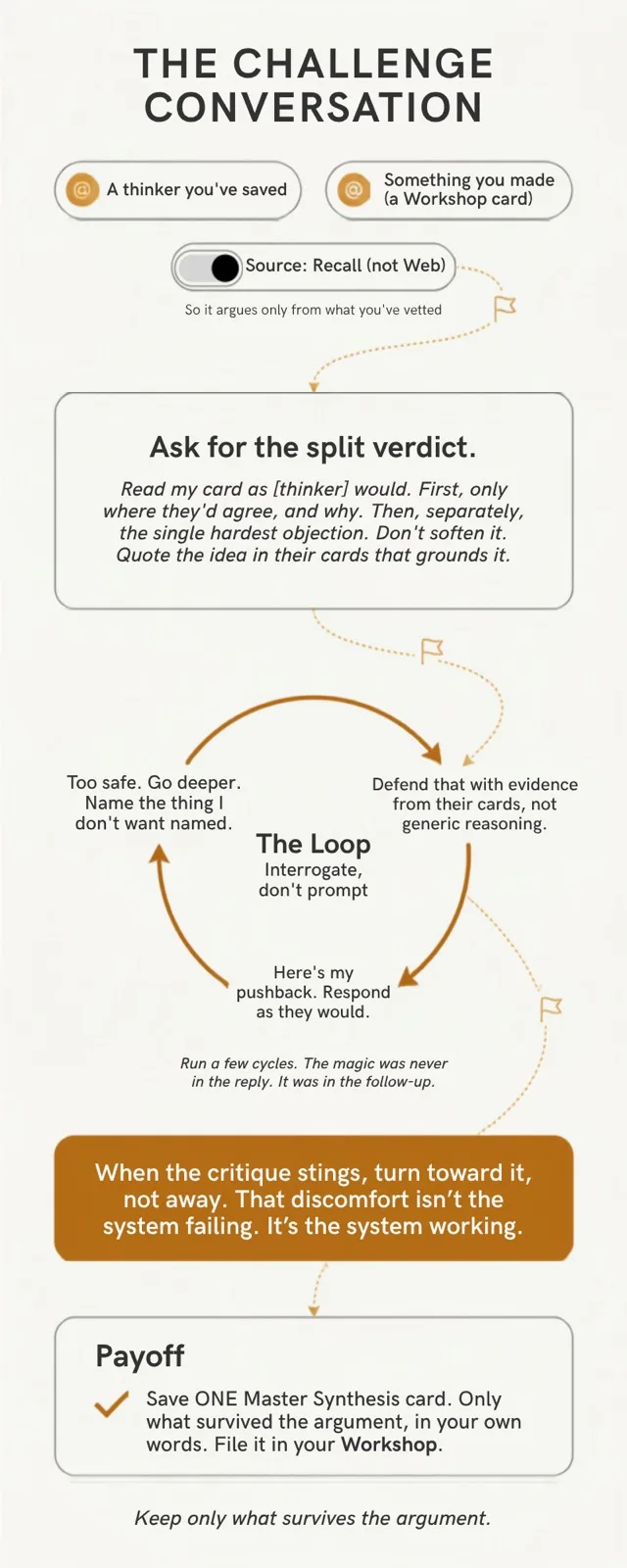
The Challenge Conversation (The How)
(I come back to why it matters most in the closing. For now, just the how.) Set your chat source to Recall so this is built only from what you’ve saved. Then @ mention two things: a thinker whose cards you’ve saved, and a card you made yourself.
Prompt:
“Read @[my Workshop card] as if you were @[saved thinker]. First, tell me only where they would genuinely agree, and why. Then — separately — tell me the single hardest objection they would raise. Don’t soften it. Quote the specific idea in their cards that grounds the objection. Don’t summarize my work back to me, and don’t be agreeable to be polite.”
Next, run the cycle (this is where the real value is):
- “That objection was too safe. Go deeper. What’s the thing they’d name that I don’t want named?”
- “Defend that claim with evidence from their cards, not generic reasoning.”
- “Now I disagree because [your pushback]. Respond as they would.”
Then close it:
“Summarize what survived this argument as one Master Synthesis card. Include only the conclusions that held up, in my own framing.” Save that one card to your Workshop.
The whole move, start to finish. Steal it.
🕵️ Voices of the Field — On Tools and Mastery
- Joe Hudson: AI should amplify my thinking, not replace it. Every workaround in this chapter is really just a way of keeping me in the loop, instead of handing the thinking to the machine.
- Tiago Forte: the value was never in the capture. It’s in the distillation. The chat’s edges all show up at exactly the moment I’m trying to distill, which is exactly the moment my own judgment has to step back in.
Lookout Point Knowing a tool’s edges isn’t losing faith in it. It’s the moment you finally know how to use it.
Trail Marker
⏱ 10 min Find Your Own Edge: Ask your knowledge base a real question. If the answer disappoints you, don’t blame the chat. Run the four checks: Was my question too vague? Did I scope it to my saved content? Did it flatten a detail I needed? Or did I just not feed it enough to begin with? Find which edge you hit. That’s where your skill grows next.
⏱ 10 sec The Skim Version: Next time the chat gives you a weak answer, ask again, but narrower. Watch what changes.
Trail 9The Legacy Layer 🪧
What Changes When the Knowledge Base Stops Being Just Mine
(The Half of Recall I Almost Never Reached)
⏱ About 10 minutes to read.
Tiago Forte has a four-part method he calls CODE. Capture, Organize, Distill, Express. For too long, my Express stopped at the edge of my own Workshop. I made things, and then they sat there, useful only to me.
So I added a fifth step CODE leaves implicit. Distribute. Consume, Curate, Distill, Create, Distribute. Express is making the thing. Distribute is getting it to the person who needed it. This whole trail is about that last move, the one most second brains never make.
For most of this guide, I treated my knowledge base as a private thing. My library. My workshop. My edge. For a long time that’s all it was. A room only I ever walked into. Then I shared a single card with a friend, and something shifted.
That’s when I realized the knowledge base had a second half I’d been ignoring. Not the part where I take knowledge in. The part where I hand it out.
Here’s the shape of that second half. It happens at three scales. One card handed to one person. A profile open to anyone. A collection that shows how I actually think. Same instinct, three sizes. We’ll walk them in that order, small to large.
A Shared Card Is Not the Same as a Link
I’d saved an article, marked it up with my highlights, written a few notes in my own words about why it mattered. When I sent the link, my friend didn’t just get the article. They got the article plus my thinking about it. My highlights. My notes. The version of it that had passed through me. They read it the way I read it, without needing a Recall account, without signing up for anything.
This is the distinction that surprised me. When I send a normal link, I’m sending the world’s content. When I send a Recall card, I’m sending my version of it. A link says “here, read this.” A shared card says “here, read this the way I read it.”
For the first time, my Workshop had somewhere to go. My synthesis wasn’t only for me anymore. It could land in someone else’s hands, useful, in a single click.
From One to Many
A shared card reaches one person, the one I send it to. Public Profiles are the next scale up. The idea is simple. The cards and collections I choose to make public would live on a profile, like a lightweight, Recall-native version of Medium. People could find them, read them without signing up, save them into their own Recall, and follow me for whatever I publish next.
I want to be careful and honest here, because it matters. Profiles are on Recall’s roadmap, not in my hands yet. No release date that I’ve seen. So depending on when you’re reading this, I may be describing a room that isn’t built. (I’m writing toward it anyway. More on why in a moment.)
And when it does land, I want to be clear about what it is. It isn’t two people editing one card together. It isn’t collaboration in that sense. It’s publishing. I curate, I publish, you read and save. A one-way broadcast from my Workshop to anyone who finds it useful. That broadcast is exactly the point. It turns a private knowledge base into something that can outlive the moment I built it.
Designing Your First Playlist
This is the third scale, and the one that taught me the most. For a while I thought a public collection was just a folder I let people see. It isn’t. That was the mistake that kept mine looking like a dump. A folder is a pile. A collection is a playlist. The difference is order. The difference is me.
A pile of saved links has no author. Anyone could have saved those same articles. What makes a collection mine is the thinking I put between the links. The summary I chose. The note where I argued back. The one card I wrote that connects the other five. That connective tissue is the whole product. I started calling those connecting cards the glue.
So I keep the work small. I pick a theme I actually care about. I choose five to ten cards. Never fifty. Ruthless beats complete every time. I order them like an argument. Hook first. Payoff last. Then I write the glue. An intro card in my own words. A synthesis card where two sources collide. A closing note on what I’d do with all of it.
The glue is Workshop, not Library. A saved Huberman YouTube video is a Library card. On its own it’s just a link anyone could share. But the card where I pulled three ideas out of it and tied them to something else I’d saved? That’s glue. I string five Library cards together with my own glue between them, and suddenly the collection says something none of those links said alone.
A single shared card proves I can summarize. A well-built collection proves I can think*.** That gap is the entire reason this layer matters. I don’t just publish links. I publish my reasoning. It’s the difference between being a librarian and being a sense-maker.
🕵️ Voices of the Field — On Curation as Contribution
- Robin Good: curation as a public act. Choosing what to save for myself is one thing. Choosing what’s worth handing to others is a different, higher bar. The curator’s real product isn’t the collection. It’s the trust that the collection was worth someone’s attention.
Lookout Point A knowledge base I keep makes me sharper. A knowledge base I share makes me useful. Only one of them outlives me.
Why I Call It a Legacy
Everything else in this guide made me sharper. This layer made me useful to other people. The compounding from Trail 6 was value accruing to me. This is that value spilling outward. To a friend. To a follower. To a stranger who finds exactly the synthesis they needed and saves it into their own Library, where it becomes the seed of their own compounding.
My knowledge becoming someone else’s starting point. That’s what I mean by legacy. Not that I knew things. That I made what I knew usable to someone who came after me.
Remember the question I asked you at the start. What do you want to be able to give, once you can finally think clearly? This is the answer I found. Not a sharper version of me, kept to myself. The part of my thinking I could hand to someone else, and have it become the seed of theirs. The whole guide was quietly walking toward this question the entire time.
That’s also why I’m building toward Profiles before they exist. When they land, I’d love to open a public “Showroom” of the cards behind this guide. My Workshop, made visible. Maybe that’s worth thinking about for yours too. The best Showrooms probably won’t be the ones thrown together the day the feature ships. They’ll be the ones quietly built before it.
Trail Marker
⏱ 15 min**Write One Piece of Glue:*** Pick three cards on the same theme. Don’t publish them yet. First write one new card explaining why those three belong together. That card is the glue, the only one of the four a stranger couldn’t have made.⏱ 10 secThe Skim Version: A folder is links. A collection is links plus your glue. Go write one piece of glue.
ObjectionsThe Honest Objections 🤔
(The “Yeah, But…” Chapter)
⏱ About 4 minutes. The doubts I would have too.
If you’ve read this far with a little skepticism, good. I’d be skeptical too. So before you go, here are the objections I hear most, answered straight.
➡️ “Isn’t this just another system I’ll start and abandon?”
Probably, if you try to build all of it at once. That’s why Trail 0 asks for three saves and one question, and nothing else. I’m not asking you to adopt a system. I’m asking you to take one walk and see if anything pulls you back. If it doesn’t, you’ve lost five minutes. If it does, you’ve found the thread. Start that small and abandonment stops being the risk.
➡️ “Do I actually need Recall, or do these ideas work anywhere?”
The thinking, connect what you save, separate collecting from creating, is yours to keep no matter what tool you use. But I won’t pretend the tool doesn’t matter. This whole system clicked for me because Recall surfaces connections I’d never make by hand and lets me chat across everything at once. I built this inside Recall because it’s where the ideas finally worked. I’m showing you the version that worked for me.
➡️ “Isn’t AI just going to do all of this for me soon?”
AI can summarize. It can search. It can draft. What it can’t do is decide what matters to you, or connect a podcast you heard to a belief you hold. That judgment is the part that’s yours. AI gave everyone the same brain. The thing that makes you different is what you’ve thought about and how you’ve connected it. This guide is about building exactly the part AI can’t hand you.
➡️ “I already have thousands of saved things. Where do I even start?”
Not by fixing the pile. That’s the mistake I made, and it nearly made me quit. You start forward, not backward. Take the next thing well. Save it, then actually connect it. Build the habit on what comes next, not on the backlog. Then, once a month, spend fifteen minutes letting go of old clutter. The backlog isn’t where you start. The next connection is.
➡️ “Why should I trust someone who’s only been doing this a few months?”
You shouldn’t trust me because I’m an expert. I’m not. I’m a few months in, still figuring it out, still getting things wrong. Trust this because it’s honest, written while the lessons are fresh enough to still sting, not polished into advice from someone pretending they had it figured out all along. I’m not above you on this trail. I might only be a little further down it.
➡️ “Isn’t this just productivity-guru repackaging?”
Fair suspicion. But I’m not selling you a morning routine or a tagging template to copy. Most of this guide is me admitting what didn’t work and what I almost gave up on. It’s confession, not tactics. And the point runs opposite to most productivity advice. Simon Sinek says we’ve become obsessed with output, the result, the finished thing, when the real growth was always in the process of making it. Collecting is chasing the output. Connecting is doing the work that actually changes you. This guide isn’t about saving more. It’s about not skipping the part that makes you sharper.
➡️ “Isn’t this just anxiety management dressed up as productivity?”
Honestly, it can be. I’ve done exactly that. I’ve reorganized tags to feel calm instead of doing the harder thing the system was meant to free me for. So I won’t tell you the risk isn’t real. I’ll tell you what I do about it. I ran my own guide past Dr. Julie Smith’s work, and her challenge stuck. A system built on audits and rituals can quietly become a way to avoid the discomfort of not-knowing. The fix isn’t to abandon the structure. It’s to keep one honest question close. Is this freeing me to think, or am I just tidying to feel in control? Organizing is the junk food. The thinking is the meal. So I keep the question close, and it keeps me honest. That one habit is what turns the system from a place to hide into a place to think. Ask it, and the structure stays in service to you, which is exactly where it belongs.
If you had every one of these doubts, good. I did too. None of them stopped me, and none of them have to stop you. You don’t need to believe the whole thing today. You just need to take the next walk.
TakeawaysWhat to Carry Out of Here 🎒
If I could hand you only one page, this is the one
(The whole walk, pressed flat enough to pocket) ⏱ About 3 minutes.
If this guide were a trail, these are the stones worth carrying home. Not the scenery. The few heavy things.
1. Collecting was the lie I believed longest.
I had been collecting knowledge without ever integrating it. A thousand saves sitting alone are worth almost nothing. What compounds is the web between them. The work and the payoff are separated by months, so it feels like nothing for a long time. It wasn’t nothing. It was compounding.
2. I wanted a partner, not a project.
Every tool before this one made me do all the work. Then I stopped just saving and started connecting it and chatting with it. That was the moment the pile started acting like a brain. The shift wasn’t the app. It was that I finally met it halfway.
3. I stopped managing a system and started building a thought process.
For years I confused the two. I tuned themes. I nested pages seven layers deep. I was managing a system, not a thought process. The fix was one honest question I now run on every card. Did I collect this, or did I create it? That one question was the single most important change I made.
4. Curation and creation are two different acts.
You need both, kept distinct. A curator who never creates is just a librarian. A creator who never curates runs out of raw material. The thing only I can make is the glue, the card that ties the others into one thought. A single shared card proves I can summarize. A collection proves I can think.
5. The identity comes first. The habits just prove it true.
I am not someone who uses Recall. I am someone who thinks in connections. I didn’t tag to earn a tidy library. I tagged because that’s what a person like me does. Each small save was a quiet vote. The habits built the identity, not the other way around.
6. Letting go was the hardest skill, and the most freeing.
I clung to rotting tags because deleting them felt like admitting I’d been wrong. Then I borrowed two words. Let them. And then, let me. Let them be the mess I made before I knew better. Let me choose what stays now. The orphan tags didn’t need defending. They needed releasing.
7. The skill was never prompting. It was interrogating.
I used to take the first answer and leave. The magic was never in the reply. It was in the follow-up. The chat isn’t a vending machine. It’s a thinking partner that only gets as far as you’re willing to walk with it. The tool didn’t get smarter. I did.
8. The bridge gets built. Crossing it is on me.
The best connections come in the moment, while I’m still reading. The tool can put the bridge in front of me. It can’t make me cross it. So I learned to move before “I’ll do it later” wins. The feature isn’t here yet. The discipline can be.
9. The last half is the one almost no one reaches. Hand it out.
Everything else made me sharper. This part made me useful to someone else. My knowledge becoming someone else’s starting point. That’s what I mean by legacy. Not that I knew things. That I made what I knew usable to someone who came after me.
10. The tidy library can become the hiding place.
A guide built on audits and rules has a trap built into it. The organizing can quietly become the point. I caught myself managing the system to avoid the harder work it was supposed to free me for. So I keep one question close. Is this freeing me to think, or is it a sophisticated way to avoid sitting with the discomfort of not-knowing? The day I stop asking is the day the tidy shelves quietly take over.
ClosingClosing 🏔️
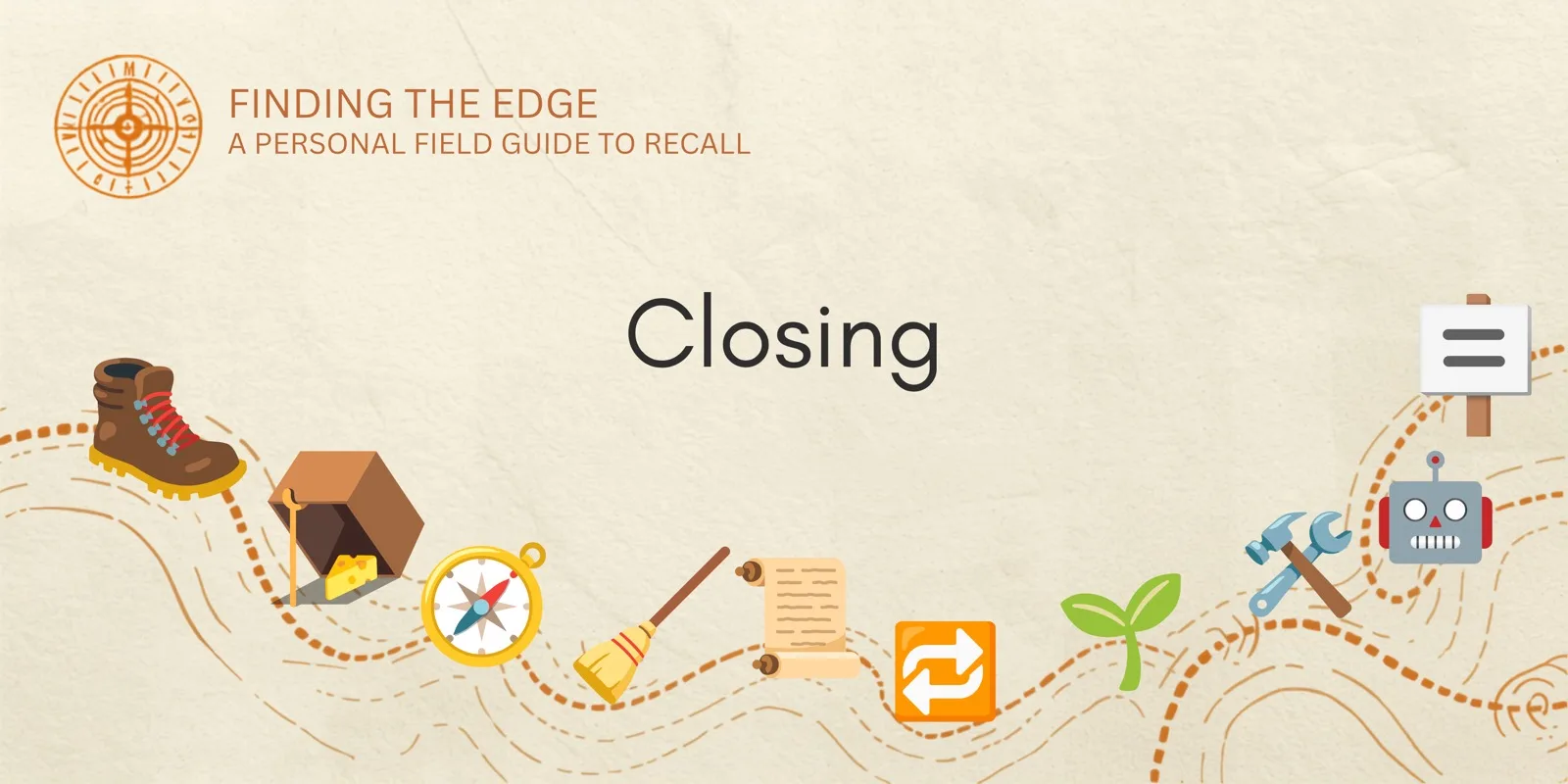
So far, that’s the trail as I’ve walked
⏱ About 2 minutes.
I’m not going to end this with one more assignment. You’ve had enough Trail Markers. So I’ll leave you with the one move that mattered most to me.
I find one card in my Workshop. Something I actually made. A synthesis. A set of notes. A connection I’m proud of. Then I hand it to one person who’d genuinely benefit. Not a link to the original article. My version of it. The one with my thinking baked in.
That’s the heart of it. Take something the world gave you, make it yours, and pass it on.
The Challenge Conversation (Why I Saved it for Last)
(The Reason Why I Want You to Steal It)
The mechanics are back in Trail 8. The prompt, the cycle, the Master Synthesis card at the end. I’m not repeating them here, and that’s on purpose. The prompt was never the point. What it’s for is.
There’s one more thing I owe you. Not the move itself, but the reason it mattered most.
I didn’t get it from Dr. Julie Smith directly. I got it by doing the work this guide keeps describing. I sat in the Recall chat with my Dr. Julie cards and asked them to read this guide as she would. Where she’d nod. Where she’d push back. You don’t need the person. You need their cards and a question.
Then I pushed back when the first answer was lazy. I ran it through a few cycles. That’s not the chat being clever. That’s me thinking out loud with a partner who’d read everything I fed it.
And when the challenge stung, when it named the thing I didn’t want named, I learned not to defend. I turned toward it with curiosity instead. I asked what it was really telling me. That discomfort wasn’t the system failing. It was the system working. It was the exact not-knowing this whole guide was built to help me sit with, instead of organizing my way around.
Final Lookout Point The library is the means, not the life. If you ever catch yourself organizing instead of living, the tidy shelves have stopped serving you.
So now I try to keep one question close. It’s the one that came out of that conversation with Dr. Julie’s cards: Is this system freeing me to think? Or is it a sophisticated way to avoid sitting with the discomfort it was built to solve?
I don’t have a clean answer. But I noticed the guide had already been answering it the whole time. The nested pages I confessed to. The maze my Notion became. That was the trap, and I’d already lived in it. So I built the fix around it. The one question on every card. The empty Workshop that tells me I’ve been hoarding. The audit that’s about releasing, not controlling. None of that makes me immune. The clutter still drifts back. The itch to organize still shows up.
The system only frees me as long as I keep asking questions. And asking is simple enough that I never have to get it perfect. I just have to keep asking. That’s the whole discipline, and it’s one anyone can keep.
VoicesThe Voices of the Field 🕵️
Everyone Who Walked This Trail With Me
⏱ About 4 minutes.
I walked these trails and tried to leave a map. Most of what’s in this guide didn’t come from the names below. It came from years inside the second brain idea, and a lot of plain trial and error. I got a lot of things wrong. I rebuilt the system more than once. I learned most of it the slow way.
The people I quoted didn’t hand me the answers. They sharpened them. I’d take an idea from one of them into Recall and argue with it. I spent many hours in the chat (more than I’d admit to my future self), not nodding along, but pushing back. Disagreeing. Asking it to defend a claim, then tearing the answer apart and asking again. Recall is where I held those conversations. It let me connect what each voice said to what I already believed, and keep only what survived the argument.
Two of them shaped me more than the rest. Tiago Forte gave me the architecture. The idea that capturing is the easy part, and the real work is distilling and expressing, is the spine this whole guide stands on.
Brendon Burchard gave me the urgency. He named information overload as a real cost to how I think and perform, not just clutter to tidy later.
One handed me the system. The other handed me the reason to use it. I got to meet them both. Two people whose ideas I argued with for weeks until the ideas became mine.
So the voices boosted my thinking. They didn’t replace it. The ideas here are mine because I did the work of making them mine. And one day, in your own guide, your name belongs on a list like this. That’s not a metaphor. That’s the entire point.
The Architects of the System (who gave me the system)
-
Tiago Forte Building a Second Brain; the CODE method; the “Context Architect” idea. He gave me the architecture this whole guide stands on. His four steps, Capture, Organize, Distill, Express, showed me that saving was the easy part and the real work was everything after it. Most people get stuck on the first two letters. The Library and Workshop split is just me forcing myself into the last two. Books: Building a Second Brain, The PARA Method · YouTube: @TiagoForte · X: @fortelabs · Web: fortelabs.com
-
Robin Good (Luigi Canali) The spine of Trail 9. He gave me the language for the thing I couldn’t name: that curation and creation are two different acts, and confusing them is why most knowledge work goes nowhere. His shift from “content creator” to “cultural curator” is why I stopped hoarding links and started publishing my own reasoning. Also his rule I keep close: use AI as an options generator, not a writer.
-
Andrej Karpathy The personal LLM knowledge base. He put a name to the thing I was building without realizing it had one: a version of yourself that remembers everything you’ve learned. That one phrase reframed my whole knowledge base from a filing cabinet into something closer to an external mind.
-
James Clear Atomic Habits. He flipped the order I had backwards. I thought the system would eventually make me organized. He showed me it runs the other way: you become someone who thinks in connections first, and the tidy knowledge base is just what that person leaves behind. Every small save is a vote for who you’re becoming.
The Ones Who Named the Pain (who showed me why I needed it)
- Cal Newport The “cognitive shallows,” and “cognitive fitness” as the way back. A diagnosis of the scroll, framed as reversible. Books: Deep Work, Digital Minimalism
- Dr. Gabor Maté Scattered attention as a soul-level disconnection, not just a productivity glitch.
- Brendon Burchard “Information overload is destroying your mental performance.” Also the case for maintenance as a non-negotiable ritual.
- Simon Sinek People confuse goals with purpose. The “I’ll be happy when” trap, told as a why-not-what problem.
The Mindset & Discipline Voices (who helped me stick to it)
- Mel Robbins Used more than once. The “I’ll be happy when” trap, and the Let Them Theory (let them, let me) that powers the Audit.
- Dan Koe “Don’t find a niche. Become the niche.” Discipline as freedom, and focus as an environment you build.
- Naval Ravikant The compounding of knowledge. The quietest curve, flat enough to make you quit right before it bends.
- Ed Mylett “Your obsessions become your possessions.” And the piñata, progress invisible until the candy spills.
- Alex Hormozi Patience is figuring out what to do in the meantime. The work compounds while you’re not watching.
- Tony Robbins Consistency over intensity. Five small habits beat one heroic week.
- Mark Manson”We don’t need more time, we need less fear.” The friction isn’t time, it’s the small fear of stopping to link.
- Codie Sanchez “Silence is actually a superpower.” Most content doesn’t deserve a save.
- Sahil Bloom The “Time Billionaire.” Tagging well today is a gift mailed to my future self.
- Master Shi Heng Yi Distraction is something we allow, not something done to us.
- Joe Hudson AI should amplify my thinking, not replace it. The principle behind every workaround in Trail 8.
- Matthew McConaughey Greenlights. “Finding your identity is more a process of elimination than discovery.” And the persist, pivot, or concede frame.
- Chris Williamson The conversation that surfaced Naval’s compounding idea for me.
- Max Bernstein AI output disappoints when it lacks context. His “Cognitive Fingerprint” idea, using AI to surface the patterns that make your expertise yours, is what convinced me a personal knowledge base gives the AI the “me” layer it’s missing.
The One Who Questioned the Guide Itself (who tested whether it was even healthy)
- Dr. Julie Smith Psychologist. The voice I pointed back at my own work. I didn’t borrow an idea from her. I asked my saved Dr. Julie cards to read this guide as she would, and challenge it. She’s the reason the Final Lookout Point exists. She’d warn that a guide built on audits, constitutions, and monthly rituals could quietly become a control behavior. A way to manage anxiety by organizing instead of living. Her question stuck with me: Is the tidy library serving you, or are you using it to avoid the discomfort of not-knowing? She also taught me what to do when that challenge stings. Turn toward it with curiosity, not defense. Every other voice here thought out loud and I got to think alongside them. She’s the one who thought against me.
The People Who Built the Tool
- Sankari Nair (“Sanks”) and Paul Richards Recall’s co-founders. They lived the same drowning-in-content problem before they built the fix. Quoted from the co-founder guide and the launch.
So that’s the roll call.
Don’t take my borrowing as the final word. I only showed you the doorways. The rooms are theirs, and they’re worth walking into yourself. Go read the source, not just my version of it.
That’s the quiet trade every one of these names made with me without knowing it. They thought out loud, and I got to think alongside them. The least I can do is pass the same invitation forward to you.
AheadThe Trail Ahead ➡️
This guide is finished, but it’s not the whole plan. Here’s where it keeps going: The Newsletter (Early July 2026)
This guide keeps growing. New trails, new lessons, the ones I’m still figuring out. The living version lives at optimizedsimplicity.com. Follow along and you’ll get the new trails as I write them.
The Trello Board
Prefer to see it laid out visually? Copy Finding the Edge: The Trail Board to your own Trello account. Every trail is a card, every Trail Marker is a checklist you can tick as you go. Walk one trail at a time, at your own pace.
The Cinematic Companion (Late July 2026)
What movies taught me about knowledge management. Same ideas, told through movie scenes instead of creator citations. Two doors into the same room. Read either first.
And if you’d rather build your own system with a little help, you’ll find me at ricardoyoule.com.
Finding the Edge · Version 1.6 · © 2026 Ricardo Youle (Optimized Simplicity)
Frequently asked questions
How do I build a second brain in Recall?
Start impossibly small, the way Ricardo does on Day One: install the Recall browser extension, save three pieces of content you genuinely care about, and open one card to ask it a real question in chat. Don’t bulk-import your bookmarks or design a tag system first. Once saving feels natural, the later trails add tagging rules, a monthly audit, and the split between what you collect and what you create.
How should I organize and tag a second brain?
Lean on Recall’s automatic tagging at first, then add a light structure as you go. Ricardo’s tagging constitution is four rules: give every card a layer tag and a format tag, save the synthesis rather than the whole conversation, tag it before you close the tab, and treat a short monthly tidy as non-negotiable. The goal isn’t a perfect taxonomy, it’s keeping cards findable and connected.
How often should I clean up or audit my knowledge base?
About once a month, and keep it to roughly fifteen minutes. Ricardo runs a three-step ritual: clear out orphan cards, sort anything mislabeled into “collected” vs. “created”, and tidy fractured tags so the same idea doesn’t live under four different labels. An audit is more emotional than technical, its real job is giving you permission to let go of clutter you saved before you knew better.
How long before a second brain starts to pay off?
Usually months, not days, which is why most people quit around week eight. The work of connecting cards and the payoff of seeing them compound are separated in time. Collecting alone never compounds; connecting does. The payoff arrives suddenly, when Recall surfaces a link between things you saved weeks apart and they form a single answer you couldn’t have assembled from memory.
How is a second brain different from bookmarks or a notes app?
Bookmarks and most notes apps store things in isolation: a wall of links and cards you have to remember to reopen. A second brain in Recall summarizes each save, tags it, connects it to related cards automatically, and lets you chat across everything at once. The difference is connection and retrieval, a bookmark says “here’s a link,” a second brain says “here’s what this connects to and what you already know about it.”
I already have thousands of saved items. Where do I start?
Don’t start by fixing the pile, that’s the mistake that nearly makes people quit. Start forward, not backward: take the next thing you save and actually connect it, then repeat. Once a month, spend fifteen minutes letting go of old clutter. The backlog matters far less than building the habit of connecting what you save from here on.