AI for Writing and Research: A Six-Part Workflow
Recall is built to be strong at both halves of this workflow: generating content and doing research. What ties them together is one core principle, your knowledge compounds. When you write, you’re not starting from a blank page and the generic internet; you’re building on the sources, notes, and drafts you’ve already gathered. When you research, every source you save and every answer you keep makes the next session smarter. Both feed the same knowledge base, and that base grows more valuable every time you use it.
That’s the difference between Recall and a general AI tool. There are two problems with how most people use AI today. When you use AI for writing, the output is generic, ask ten people to write about the same topic and you get ten versions of the same article, all in the same flat voice. And when you use AI for research, nothing compounds: every chat starts over on the open internet, so what you learn today doesn’t build on what you learned yesterday. There’s no loop.
Recall fixes both because it grounds everything in your own knowledge base instead of the open web. You use AI for research that adds to a base that compounds over time instead of being thrown away, and AI for writing that starts from your own thinking and your own sources, so the draft sounds like you, not like the internet average. The more you save, summarize, and write in Recall, the better the next piece of research and the next draft become.
In the video, Recall co-founder Sanks uses SEO and AEO research as the example. The same six steps work for a blog post, meeting prep, a research deep dive, social posts, or anything else where you want your knowledge to compound over time.
Why this workflow matters
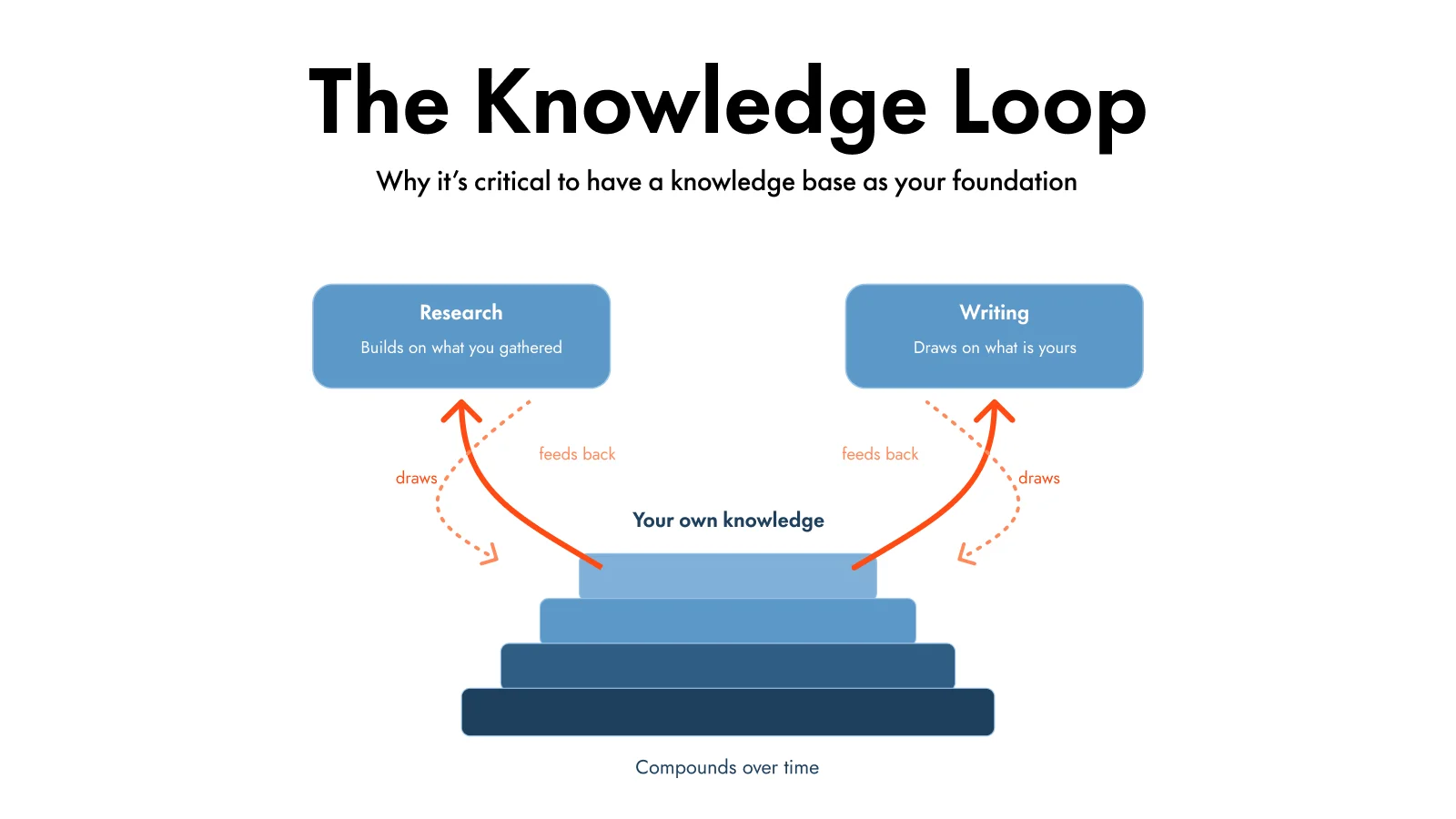
The knowledge loop: research builds on what you’ve gathered, and writing draws on what’s yours, both feeding back into your Recall knowledge base as it compounds over time.
When you use AI as a chatbot, its answers are grounded in two things only: the open internet, and whatever the model remembers about you. That creates the two problems above:
- Research doesn’t compound. Every chat starts from scratch on generic, untrusted sources. Nothing connects to what you already know, so there’s no loop and your knowledge never builds on itself.
- Writing all sounds the same. When AI writes from the internet average instead of from you, the output is generic. Everyone using the same tool on the same topic ends up sounding identical, and your perspective disappears.
This workflow solves both. Using AI for research that starts from your knowledge base turns one-off chats into a compounding loop: every source you save and every answer you keep makes the next session smarter. Using AI for writing that starts from your own thinking and sources means the draft is grounded in your voice, so it reads like you wrote it, not a machine.
What you’ll build
- A topic-specific research knowledge base in Recall, for example
Nutrition,AI Agents, or2027 Predictions. In the video below, Sanks usesSEO and AEO: how to get your brand to show up in AI search. - Best-practice checklists grounded in trusted sources that you can iterate on over time
- Notes grounded in your own thinking, captured before AI writes anything
- Drafts that combine your best-practice checklist with your perspective
- A final cross-reference check against your sources before publishing
Watch and follow along
Expand each part below for the step-by-step instructions. Click the timestamp on any part to jump straight to that moment in the video.
Part 1Research
When you research in Recall, it always looks to your own knowledge first and the internet second, so every answer stays grounded in the sources you’ve chosen to trust rather than the generic web.
Use AI for research that starts from your own knowledge. Open global chat in the left panel by clicking the AI icon and ask your research question with Recall + Web enabled, so Recall prioritizes your saved sources first, then goes wider when needed.
Example prompt:
I’m trying to learn about SEO and AEO. I’m completely new to this. Who are the experts in the field I can learn from? What fundamentals do I need to know? How do I go from knowing nothing to being dangerously competent over the weekend?
After the first answer, ask what you’re missing:
Who am I missing as experts that are not in my knowledge base? Are there recent sources, people, or ideas I should be following?
When the answer is useful, click Add to Notebook and save the chat under a topic tag, for example SEO and AEO. To go deeper on a recommended source, save it with the browser extension, by pasting a link in the app, or via the mobile share sheet, then chat with it while @ mentioning the broader topic tag so it’s interpreted against everything you already know.
Use citations and blue source chips to jump to the exact moment in a video or podcast, and Deep Research to search across related cards. The point isn’t to consume everything, it’s to decide what deserves your full attention.
Part 2Understanding
Saving sources isn’t the same as understanding them. Once you’ve collected the core material, generate questions to check whether it actually stuck.
From any source, click Generate Questions. You can:
- Test yourself on the reader (the transcript) alone, or include your notebook notes.
- Pick the question types, difficulty, and whether to include explanations and hints.
- Turn any quiz into a public challenge to compete with friends learning the same topic.
- Add the questions to your spaced repetition review so they resurface right as you’re about to forget them.
To see everything you can do here, including all the question types, challenges, and review scheduling, take a look at Recall Quiz 2.0 and spaced repetition.
Use this step when you want to write and speak confidently about a topic, not just collect links.
Part 3Best practices
This is where your research and learning turn into something that compounds. Instead of letting what you’ve gathered sit as a pile of sources, you distill it into a reusable best-practice standard you can apply every time, and keep improving. Each new thing you learn gets folded back into the same checklist, so your standard gets sharper with every project instead of starting over.
In global chat (click the AI icon in the left panel), @ mention your topic tag, and switch to Recall only (no web search). When you’re building a best practice, where the answer is grounded really matters.
Example prompt:
Generate a best-practice guide for the steps I should follow to ensure my content is both SEO and AEO optimized when I write a blog. Also generate a specific checklist I can use before posting. Make it holistic: metadata, schema, FAQs, originality, structure, and anything else from my knowledge base that is relevant.
Save the checklist to your notebook under a clear tag, for example SEO and AEO / Best Practices. As you learn more, add to this card so it compounds over time instead of being a one-time AI output.
Part 4Your thinking
This is the most important part, and the one most people skip. If you look to AI for an answer first, you bias your thinking and limit your creativity. So start with a blank page.
Recall isn’t just for saving sources, it has a rich note-taker built in. Click the pen icon (✎) next to Add Content to create a blank note, hit /, and you get a full block-style editor with everything you need to capture your thinking properly: headings, lists, to-dos, callouts, and more. Learn what it can do in AI note-taking in Recall.
In Recall, create a blank note and brain-dump your own perspective. For Sanks’ example, this was a note called ChatGPT versus Recall blog. The goal isn’t to write perfectly, it’s to capture the ideas, angles, and framing that should be yours. If voice-to-text helps you think faster, use it.
Starting with your own thinking is what keeps your writing unique. Let AI react to your perspective, instead of replacing it.
Part 5Generate, don't conjure
Now use AI for writing by combining three ingredients instead of conjuring from nowhere:
- Your topic research tag
- Your best-practice checklist
- Your own thinking note
If you’re writing for search, you can also reference a tag of competitor or ranking content, such as ChatGPT alternative.
Example prompt:
I’d like to write a blog on ChatGPT versus Recall. I want to rank for the keyword ChatGPT alternative, but please reference the existing blogs that are already ranking. Also reference my own note and the best-practice checklist. How should I structure it, and can you produce a first draft?
Add the draft to your notebook, then edit it and make it yours before publishing. The draft is grounded in your ingredients, so it’s a starting point you shape, not a final answer you copy and paste.
Part 6Cross-reference
Before publishing, run the draft back through your best-practice checklist. This is more than a spell check.
Example prompt:
Can you run a full check of this blog against the best practices we just put together, ensuring that it is both SEO and AEO optimized? Please also remove any em dashes and unnecessary colons.
After publishing, use the browser extension on the live page and run one final check:
Can you please run a final SEO and AEO checklist on my now published blog?
This checks the output, not just the draft. Recall can inspect the live page context, including metadata and schema, so you catch issues that are easy to miss before publishing.
Related Recall features
- Chat with all your content
- Note-taking in Recall
- Quiz and spaced repetition
- Graph overview
- Recall augmented browsing
Related guides
Frequently asked questions
What is the best AI for writing?
How do I use AI for writing without sounding generic?
What is the best AI for research?
The best AI for research is one where your work compounds instead of resetting every session. Most AI research is a series of one-off chats on untrusted, generic sources, so nothing you learn today builds on yesterday. Recall fixes this by letting you use AI for research grounded in your own knowledge base: every source you save and every answer you keep makes the next session smarter, turning research into a compounding loop.
How is AI for research in Recall different from using ChatGPT?
A standard chatbot grounds its answers in two things: the open internet and whatever it remembers about you. Recall’s AI for research grounds answers in your saved sources first (with optional web search), and lets you save useful answers back into your knowledge base under topic tags. So instead of throwing away each chat, you build a trusted, connected research library that you can @ mention and chat with later.
Can I use AI for writing and AI for research together?
Yes, that’s the whole point of this six-part workflow. You use AI for research to build a topic knowledge base and a best-practice checklist, capture your own thinking, then use AI for writing to combine all three into a draft. Research feeds writing, and everything you publish strengthens the knowledge base you research from next time.
Does AI for writing produce original content?
It can, if it starts from original inputs. Because Recall’s AI for writing workflow begins with your own thinking note and your own trusted sources rather than the generic web, the draft is grounded in your perspective. You then edit it to make it yours, and run a final cross-reference check against your sources before publishing.
How do I make AI-written content sound like me?
Capture your own thinking first. Before the AI writes a word, create a blank note and brain-dump your angles, framing, and opinions, then let the AI react to that note instead of replacing it. Feeding your own thinking note into the AI for writing step is what keeps your voice in the final draft.